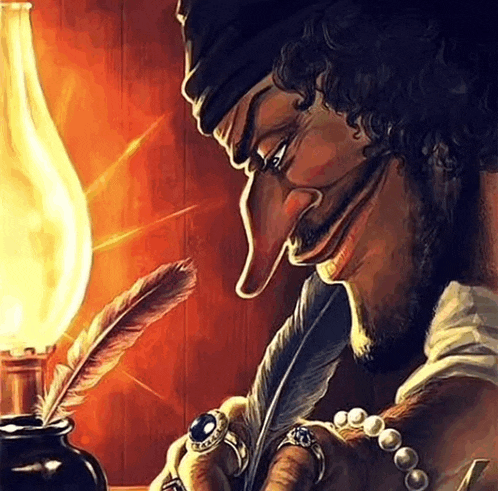
You have likely seen him on your timeline recently. He sits hunched over a desk, surrounded by the warm, conspiratorial glow of candlelight. His grin is wide, missing teeth, and bordering on the psychotic. He holds a quill with the delicate precision of a poet, yet his eyes betray the chaotic energy of a madman plotting world domination. This is Marshall D. Teach, better known as Blackbeard from the anime One Piece, and he is currently the internet's favorite representation of the writing process. But why this specific image? And why now?
I find it fascinating that we have collectively chosen a villainous pirate to represent our creative struggles. It speaks volumes about how we view the act of creation itself. Writing is not always a serene, disciplined practice involving a cup of tea and a view of the garden. Sometimes, perhaps most of the time, it is a messy, manic, and slightly unhinged endeavor. It is the feeling of connecting two disparate ideas at 3:00 AM and realizing you have either solved the theory of everything or lost your mind completely. The Blackbeard meme captures this specific frequency of intellectual hysteria perfectly.
1 The Visual Rhetoric of "Locking In"
Let us look closer at the image itself. It is not a screenshot from the anime, as many assume. It is actually a piece of fan art created way back in 2012 by a DeviantArt user named jen-and-kris1,2. The composition is striking because it balances two opposing energies. On one hand, you have the trappings of sophistication: the quill, the parchment, the jewelry, the focused posture. On the other hand, you have the character himself: a rugged, chaotic force of nature known for betrayal and violence. This juxtaposition creates a visual metaphor for what the internet calls "cooking."
When you are writing an essay the night before it is due, or drafting a backstory for your Dungeons & Dragons character that is far too tragic for a casual game, you feel like a genius and a maniac simultaneously. You are "locking in." The image resonates because it validates that internal state. It tells you that your frantic scribbling is not just panic; it is a grand scheme. I would argue that this is why the meme has traveled so far beyond the One Piece fandom. You do not need to know who Marshall D. Teach is to recognize that facial expression. It is the face of someone who has just found the perfect word to destroy their opponent in an argument.
The lighting in the piece does a lot of the heavy lifting here. It is intimate. It suggests solitude. Writing is inherently lonely, but the Blackbeard image reframes that loneliness as exclusivity. You are not alone because you have no friends; you are alone because you are busy constructing a masterpiece that the world is not yet ready to understand. It glamorizes the grind. It turns the procrastination-fueled panic of a deadline into a villainous monologue.
2 The Archeology of a Digital Artifact
The history of this image is a perfect case study in how digital artifacts hibernate. As I mentioned, the artist jen-and-kris posted this drawing, titled "Blackbeard," to DeviantArt on November 5, 20122. For over a decade, it remained relatively contained within the One Piece community. It was just good fan art. Nothing more. It sat in the digital archives, gathering dust and the occasional favorite, waiting for the cultural context to catch up to it.
Then, something shifted in late 2023. The image resurfaced on Reddit, specifically in r/DNDmemes, where users began pairing it with captions about Dungeon Masters plotting total party kills or players writing 20-page backstories for characters who would die in the first session1. This was the spark. The D&D community, with its love for dramatic storytelling and "scheming," found a kindred spirit in the pirate. But the explosion happened in April 2024, when TikTok got hold of it.
On TikTok, the format evolved. It was no longer just a static image. It became part of the "slow fade-in" trend, often accompanied by melancholic or intense music2. Users would post slideshows describing their hyper-fixations—writing fan fiction, analyzing lore, or composing lengthy text messages—and then reveal the Blackbeard image as the punchline. It became a symbol of "The Cook." In internet slang, to "cook" is to perform at a high level, to create something impressive, or to let someone speak their mind. Blackbeard became the patron saint of Cooking.
I think this timeline is instructive for anyone studying media. We tend to think of viral content as immediate—something happens, and it trends instantly. But here we have a sleeper agent. A piece of art that waited twelve years for the humor of the internet to align with its specific energy. It suggests that the internet is not just a stream of new information, but a vast, chaotic library where nothing is ever truly lost. It just waits for the right librarian to pull it off the shelf.
3 The Semiotics of the Villain-Scholar
We must ask ourselves an interesting question: Why a villain? One Piece has plenty of heroes. The protagonist, Luffy, is beloved. But you would never use a picture of Luffy to represent writing a dissertation. Luffy acts on instinct. He punches first and asks questions never. Writing, by contrast, is premeditated. It requires plotting. And in fiction, plotting is the domain of the villain.
Blackbeard is a schemer. He is patient. He spent decades on a rival's ship, waiting for one specific devil fruit to appear so he could steal it and begin his rise to power4. He understands history and uses it to his advantage. When we write, especially in an academic or creative context, we are engaging in a similar kind of architectural thinking. We are building arguments. We are laying traps for the reader. We are structuring information to achieve a specific effect.
There is a subversive thrill in identifying with the bad guy. It allows us to feel powerful in a situation where we are usually powerless. When you are drowning in research papers or staring at a blank page, you feel weak. Adopting the persona of a pirate warlord is a defense mechanism. It allows you to say, "I am not struggling; I am plotting." It reframes the intellectual labor as an act of conquest.
Furthermore, the meme often leans into the absurdity of the content being written. You will see captions like "Me writing the most heart-wrenching dialogue for two fictional characters who have never met" or "Me explaining to my professor why I need an extension using a lie I concocted in a fever dream." The contrast between the seriousness of Blackbeard's expression and the triviality of the topic is the core of the humor. It acknowledges that we take our little internet hobbies and our undergraduate essays with deadly seriousness. To the outside world, it is just a fan fiction. To us, in that moment, it is the history of the world.
So, the next time you find yourself at your desk at 2:00 AM, surrounded by open tabs and empty coffee cups, feeling that manic rise of inspiration, you know who you are. You are not just a student. You are a captain of the high seas, and you are writing history. Or at least, you are writing a really convincing email to your TA.
References
Andaloro A. The ‘Blackbeard Writing’ meme from ‘One Piece,’ explained. The Daily Dot. 2024. Available from: https://dailydot.com/blackbeard-writing-meme
Know Your Meme. Blackbeard Writing. Know Your Meme. 2024. Available from: https://knowyourmeme.com/memes/blackbeard-writing
Oreate AI. Blackbeard Writing Meme Origin. Oreate AI Blog. 2024. Available from: https://www.oreateai.com/blog/blackbeard-writing-meme-origin/
Bath Harbor Marina. The Legend of Blackbeard Writing: Fact, Fiction, and Internet Memes. Bath Harbor Marina. 2024. Available from: https://www.bathharbornc.com/post/the-legend-of-blackbeard-writing-fact-fiction-and-internet-memes